
- Admin
- May 31, 2026
- Marketing, Web Design
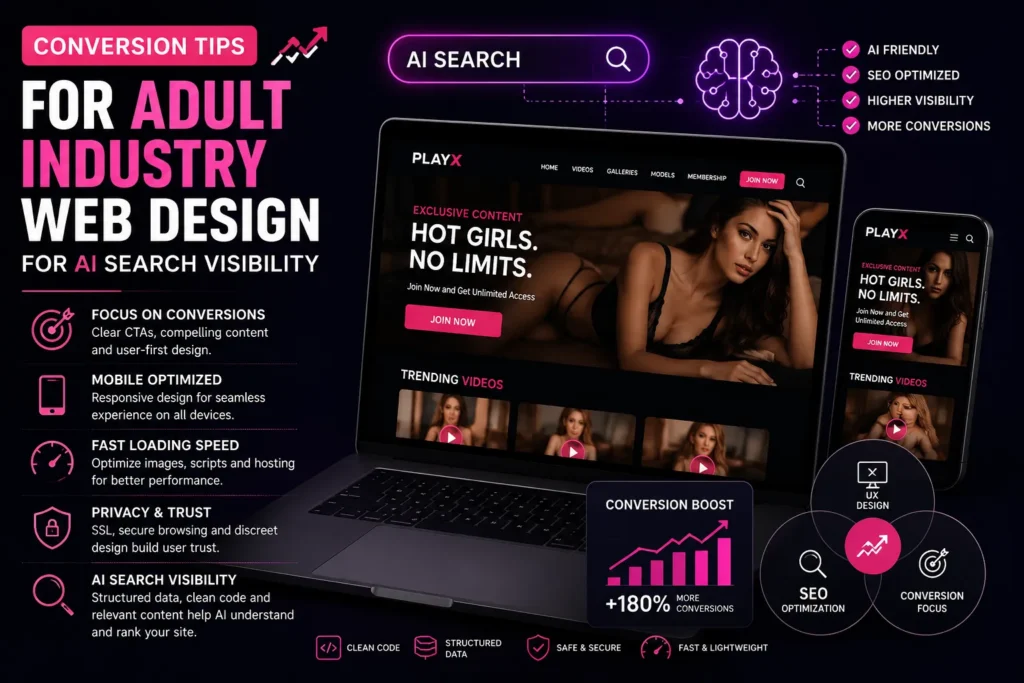
Conversion Tips for Adult Industry Web Design for AI Search Visibility
By Escort Marketing Agency (EMA) | Adult Industry Web Design | Startup Intelligence Series
The search landscape is changing quietly, and most adult businesses are unaware of its impact. As AI-driven search solutions evolve from Perplexity to ChatGPT Search, Google’s AI Overviews, and more, the sites they choose to display, cite, and suggest are shifting, too.
The criteria have changed. And the adult industry that has long struggled with getting organic visibility is now asking itself: could your website be faster, more structured, more authoritative, to be a part of the results?
For most adult platforms, at this time, the answer is: No. However, the opportunity is also here.
Speed is no longer a technical detail; it’s a ranking philosophy, a book written by the team. The team authored a book titled Speed is No Longer a Technical Detail — It is a Ranking Philosophy.
For years, the industry has been using page speed as a footnote in development. To note when auditing, recognize, and then minimize when finances come up. This reasoning is coming to an end.
While a traditional search engine uses crawlers to gather content, AI search engines do not. They synthesize it. They take from sources they think are reliable, coherent, and quick to load and treat as professionally-maintained sources. It’s not just losing conversion rate — it’s signaling to all automated systems that judge the quality of the page a negative quality signal, every time a mobile user takes four seconds to get the first meaningful content from it.
Websites with slower loading times are cited less compared to fast adult websites. They are recommended less. In an environment where AI Overviews deliver a response to a user’s query without that user having even made a click to any website, it is sites with infrastructure that communicate credibility from the first connection request that will be the ones that earn citation status.
This is not a theory.
Google’s Core Web Vitals
Largest Contentful Paint, Interaction to Next Paint, and Cumulative Layout Shift were created with just this in mind – experiential speed. The lower a site is, the less desirable its LCP score is, with anything over 4 seconds being in the lowest tier. On platforms with a big media library, a set of scripts for tracking users from three different affiliate relationships, and perhaps on unoptimized platforms, it doesn’t simply happen by accident. It’s not something that happens by chance on unoptimized platforms with large media libraries and tracking scripts from three different affiliate arrangements.
No compression of a handful of JPEGs makes a fast adult website. They are constructed by asking the questions of how to load content, how much, at what resolution, on what device, from what server location, and so on. These are the things that the difference between a platform that is treated as a platform like infrastructure and a platform that is not. These are the things that are different between a platform that is treated as a platform like infrastructure and a platform that is not.
The Speed’s Concealed Conversion Dilemma
Technically, an adult website can load in just a few seconds and yet fail to convert because of what happens when the page does load. The entry ticket is speed! Once visitors enter, their experience will determine whether they leave.
AI search visibility and conversion optimization aren’t two distinct areas of work; they’re intertwined. What makes a site usable and citable by language models makes it usable and persuasive to human users as well. AI can better process content structure by having clean heading hierarchies.
Clean heading hierarchies ease the way for AI to understand content organisation. They also aid in orienting the first-time visitor without requiring the visitor to read the map to determine their location or what action they can take. If the user is asking an implied question, short, succinct, and specific page copy will help generative engines determine to surface your content. It also helps to shorten the time in which a visitor who is on a commercial visit receives clarity, which he then needs to continue with his visit.
There is a certain pattern to conversion in the adult industry that needs to be recognized. Visitors come with a lot of questions and little belief. They have already decided on a category — they have a general idea of what they are looking for. This is what they’re asking is, is this platform worth it?
Every aspect that adds friction or requires interpretation, whether it be a navigation menu, a CTA button that’s not set off from the background, or a checkout path that asks for information in an unexpected order, erodes trust that led them to the front door. Speed gets them in. Design keeps them.
It is right here that cooperation with experts on custom adult website design is more cost-efficient than almost any other investment. General-purpose agencies create content for the typical user of a typical e-commerce site.
Adult businesses need more targeted design, which grants an understanding of the conversion psychology of the space, compliance protocols that dictate what can and can’t be displayed on landing pages, and the technical architecture of platforms that work at scale alongside media-rich content. You save on the cost of rebuilding for the most part, which most businesses fall into at 18 months of beginning with a generic template.
How AI Search Engines Make Decisions on Citation?
How it works here is more important than most adult brands know now. If a user makes a business-related query, such as “best membership websites for [category]” or “where can I find trustworthy [content type] websites,” the AI search tool doesn’t return a list of ranked results like a conventional search engine. Composes an answer based on sources that have been assessed for authority, accuracy, and structural clarity.
These three factors are the most important in that evaluation.
The first is topical depth. The focus of AI language models is on content that is specific enough to show depth of knowledge about a subject. Category pages and general landing page text aren’t cited because there is not much to get from them. Any adult platform that has a niche and publishes useful, specific content knows how to do it, and that sort of source credibility is what generative engines are looking for, whether it’s written in the same way as a mainstream brand does their thought leadership.
The second is clarity of structure. The link between your site’s words and your site’s meaning to AI systems is schema markup. An adult business without an Organization schema, a FAQ schema on pages with a lot of content, and a properly implemented breadcrumb schema is invisible for non-reason. The structure signals are not present. Most platforms have been delaying this development investment unnecessarily when they need to add it.
The third (and perhaps most surprising) is site authority as a unified signal. AI systems combine from what it considers credible sources. That reliability evaluation isn’t only regarding backlinks, while domain authority is still applicable. It also concerns the appearance of the website as an institutional site: the presence of consistent NAP information, the presence of an about page, the clarity of content ownership, the availability of HTTPS on all pages of the site, and the absence of dead-end pages that indicate that the platform is under construction. These are the criteria used to determine whether a website is an “established resource” or a “content with uncertain provenance.”
This is the Mobile Architecture Imperative
The majority of adult content is being consumed on mobile devices. This has been the case for several years. The benchmark for mobile performance has changed — and the repercussions of not meeting it.
Google’s mobile-first indexing now makes it Google’s mobile version of an adult website that dictates its performance in search results, period. A slow, but awkward and hard-to-navigate mobile version of the same site is being indexed and ranked, and it’s the mobile version that is bad. The investment in the experience of the smaller share of users and neglect of the larger share of users is one of the most common and costly errors in the industry.
Responsive CSS is only part of a mobile-first design. It’s about considering the interaction model of a user with a hand-held device, using a thumb, and probably not on a fast, secure wireless network.
The touch targets must be sized so that they can be touched without difficulty. Deep navigation should be avoided, and the most commercially relevant pages should be accessible within 2 taps. Content should be previewed progressively; it should provide the user with something as soon as possible so that they don’t have to wait for the entire asset to buffer before anything appears on screen.
Mobile site speed is a compounding factor for AI visibility, in particular. The lower the Core Web Vitals scores, the slower the mobile performance. Lower scores indicate less crawl prioritization. The crawl prioritization reduction results in less crawlable depth; whole parts of a platform’s content library could never be assessed for citations. This is a situation where big back catalogs, like those of adult businesses, are hit the hardest and gain the most when it is rectified.
Content Density as a Competitive Moat
Historically, the adult industry has not been well-served with publications. Over the years, traffic acquisition has mainly been based on SEO techniques such as targeting keywords, building links, optimizing metadata, etc., and the content part of the websites has been lacking. Low copy category pages. Headline + grid landing pages. This is a relatively ineffective method at a time when it cannot afford it.
The density of content is rewarded in a very specific way in AI search. Not for the sake of word count — long content that never gets to the point or meanders without purpose doesn’t garner authority.
The authority is gained by the kind of dense, purposeful writing that addresses a subject from multiple angles in a single page; that anticipates the questions that a reader might formulate; that addresses objections before they become set; that provides context to make the primary content more meaningful. Language models are used to determine the value of a page when deciding if it is worth citing.
This is particularly true for adult platforms, as having key landing pages that are more like editorial assets than placeholders. Creating a well-crafted platform introduction that highlights the value the platform offers, addresses user questions, and conveys clear details regarding the unique aspects of the platform is more effective for SEO than any keyword-heavy meta description ever can be. Not only is it doing conversion work, but it’s doing so as the visitor reads it, and that visitor is building a trust judgment on the spot.
The ones developing this content infrastructure now are the ones that will leverage it in the organic growth of their businesses over the next 2-3 years, before AI search becomes the primary discovery path for their audience. Citations from an AI Overview or a Perplexity recommendation when the query is commercial is like an unpaid placement on the first page. But it’s only for platforms that have gotten the structural and content job done.
What EMA see all over the industry?
Whether working with new businesses with good content and poor infrastructure or established businesses with traffic but sluggish conversions, the same common denominators exist with businesses that work with the Escort Marketing Agency.
It’s a design/speed issue, not a content size issue, which is why the gap from what a site can make to what it actually makes in conversions is nearly always a problem. Platforms that have taken the investment in making their experiences technically clean and fast loading, and mobile-friendly, beat the competition if they have more content, but lack the attention paid to the basics. The answer is simple: users transact on websites they trust. And AI systems claim to be sources that are reliable. Both share a common ground, which is speed and structure.
The second regular trend: proactive management of compliance is a competitive advantage instead of reactive. Age verification flows, placing of privacy policy, and content labeling are often seen as legal requirements that are met at the lowest possible cost. Well-designed by the adult business, these components should be easy to understand and integrated into the site’s overall design, not disruptive, which minimizes the risk of legal issues and user friction that prevents conversions.
When considering whether your site is ready to compete with AI search and grow organic traffic you already have, the questions are operational and not strategic. What is the LCP time of your key landing page on a mid-range Android device using 4G?
How much do you think it takes a new visitor to get to a conversion point from your homepage? Is your content sufficiently detailed and specific to enable a machine to quote you as a reliable source in answer to a commercial inquiry? Those three questions give you more insight into your ceiling than a traffic report does.
Closing Thought: A few words about timing
Building an AI search authority is not an open-door policy. In any search paradigm, a certain amount of citation history, authority signals, and structural advantages are gained by early movers, making it ever more difficult to beat them into the top rankings. The adult industry has been playing catch-up with mobile for many years — and many sites are still trying to close the gap. AI must not be repeated in the same cycle.
It’s not a future investment in structurally robust, fast adult web design. It’s an infrastructure choice that has revenue implications upfront and returns long-term. So, the companies that do, rather than those who wait — three years ago, that is — will shape the category three years from now.
Building that sort of foundation is the next phase in the development of your platform, and this is where our team of professionals at EMA also known as Escort Marketing Agency welcomes the discussion.